
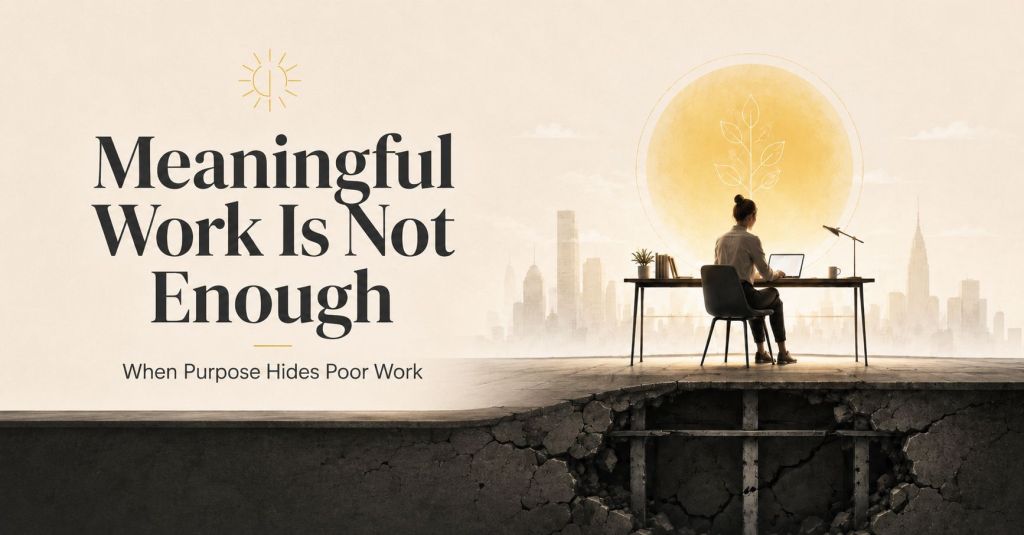
There is a strange idea spreading through modern work culture. It says that if people can find meaning in their work, they can handle almost anything: the long hours, the pressure, the unclear expectations, the constant availability, the emotional weight, the unstable role, and the sense that the job keeps asking for more than it gives back.
But meaning is not a substitute for decent work.
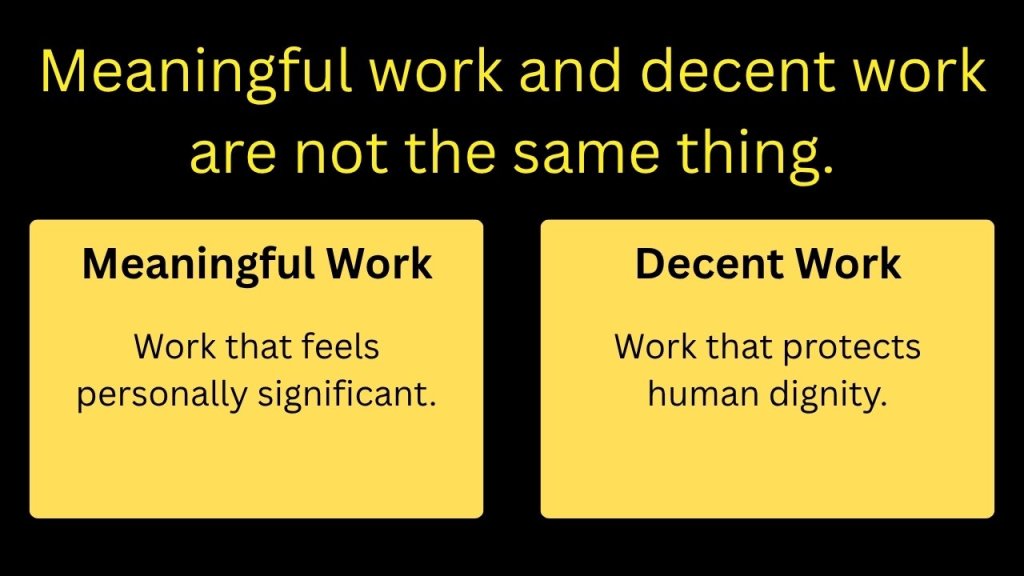
A job can feel important and still be poorly designed. A role can give someone a sense of purpose and still exhaust them. A career can look meaningful from the outside while quietly damaging the person inside it. This is one of the most important distinctions in the future of work: meaningful work and decent work are not the same thing.
Decent work comes first
Decent work is the baseline. It means work that gives people safe conditions, fair pay, reasonable hours, dignity, stability, rest, social protection, and enough security to live. It is not a luxury. It is the minimum foundation that allows people to function as human beings, not just as employees.
Meaningful work is different. Meaningful work is work that feels significant. It gives a person a sense that what they do matters, contributes to something, or expresses part of who they are.
Both matter, but they do not matter in the same order.
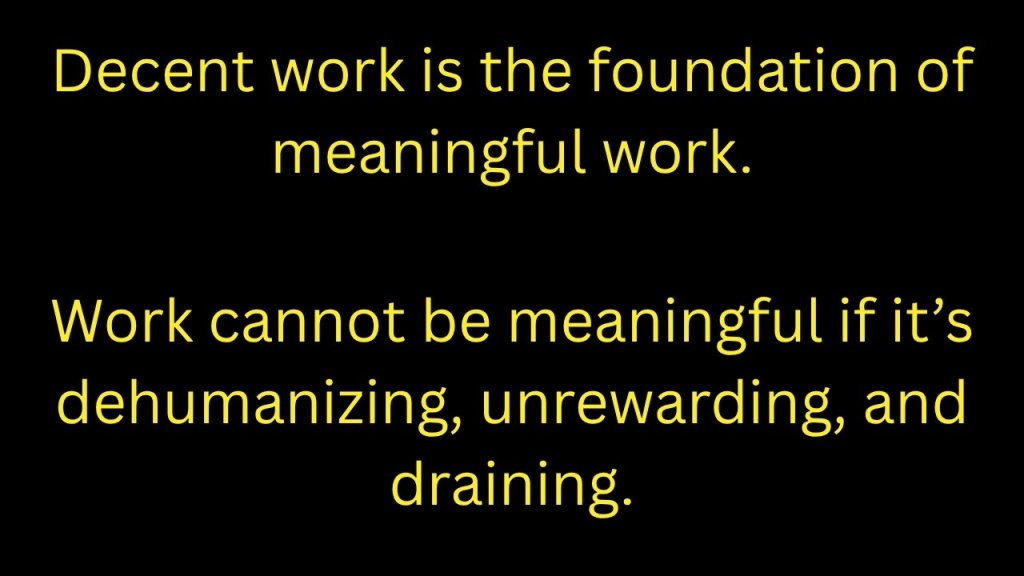
A major review on decent work and meaningful work argues that decent work is usually the foundation for meaningful work. In simple terms, people are more likely to experience work as meaningful when the work first satisfies basic human needs: survival, connection, contribution, autonomy, competence, and relatedness.
That point matters because many workplaces skip the foundation and go straight to purpose. They talk about mission, passion, impact, and belonging. But if people are underpaid, overworked, insecure, unsupported, monitored excessively, or treated without dignity, the language of meaning becomes decorative. Worse, it can become manipulative.
Purpose can hide bad work design
One of the uncomfortable truths about meaningful work is that it can make people tolerate conditions they should not tolerate. When someone cares deeply about the work, they may stay longer than they should. They may accept exhaustion as commitment. They may confuse burnout with dedication. They may sacrifice family time, health, rest, and personal boundaries because the work feels too important to step away from.
This is especially common in helping professions, startups, nonprofits, creative work, education, healthcare, and mission-driven organizations. The work matters, so people keep giving. But a meaningful job is not automatically a decent job.
A nurse can find deep meaning in helping patients while still being crushed by understaffing, trauma, and impossible shifts. A teacher can believe in education while still being underpaid, overextended, and emotionally depleted. A founder can love building a company while slowly losing health, relationships, and clarity. A recruiter, manager, consultant, designer, or project lead can feel proud of their contribution while also carrying an unsustainable workload.
Meaning does not cancel damage.
And a lot of the time, it is an illusion of meaning that overshadows what is more foundational.
The real question is not only “Do I care about my work?”
A better question is: Does this work allow me to live properly?
That question changes the conversation. It moves us away from romantic ideas of purpose and toward the actual structure of work. Can I rest? Can I think clearly? Can I recover? Can I say no? Can I do good work without constantly proving that I am working? Can I make mistakes without humiliation? Can I grow here? Can I sustain this rhythm for more than a few months? Can I still have a life outside this role?
These questions reveal whether work is built around human capacity or around endless extraction.
Individuals cannot solve everything alone
There is a lot of advice today telling people to “find meaning” in their work. Craft your role. Change your mindset. Build better habits. Reframe the work. Take ownership.
Some of this advice is useful. People do have agency. They can shape parts of their work, look for better alignment, communicate needs, redesign routines, and pursue roles that fit their strengths and values.
But individual agency has limits. You cannot mindset your way out of an abusive manager. You cannot job-craft your way out of poverty wages. You cannot productivity-hack your way out of chronic understaffing. You cannot find enough purpose to compensate for a workplace that consumes your health.
This is why decent work is not just a personal issue. It is also an organizational and societal issue. Organizations shape whether work becomes decent through leadership, workload, compensation, psychological safety, job design, flexibility, fairness, and the quality of relationships inside the workplace. Societies shape it through laws, worker protections, education, healthcare, anti-discrimination policies, and economic conditions. The individual matters, but the individual is not the whole system.
What this means for careers in the age of AI
This distinction will become even more important as AI changes work. Many people are being told that AI will make work easier. It may remove tasks. It may speed up processes. It may automate parts of jobs that used to take hours.
But that does not automatically mean work will become lighter. In many cases, faster work simply creates higher expectations: more output, more monitoring, more decisions, more accountability, and more pressure to keep up.
If AI removes the repetitive middle of work, the human may be pushed toward judgment, coordination, exception-handling, approval, emotional labor, and responsibility. That means future work may become less task-heavy but more psychologically heavy.
The question will not only be whether a job uses AI. The question will be whether the redesigned job remains decent. Does AI create more breathing room, or does it intensify the workload? Does it help people make better decisions, or does it make them accountable for systems they do not fully control? Does it increase autonomy, or does it increase surveillance? Does it improve work quality, or does it simply raise the volume of expected output?
This is where career strategy must evolve. It is no longer enough to ask, “What job is meaningful to me?” We also need to ask, “What kind of work structure can I survive, grow in, and remain human inside?”
The best work is not only meaningful. It is decent enough to let meaning survive.
Main Reference:
Blustein, David L., Evgenia I. Lysova, and Ryan D. Duffy. “Understanding Decent Work and Meaningful Work.” Annual Review of Organizational Psychology and Organizational Behavior 10 (2023): 289–314. https://doi.org/10.1146/annurev-orgpsych-031921-024847


Leave a Reply