
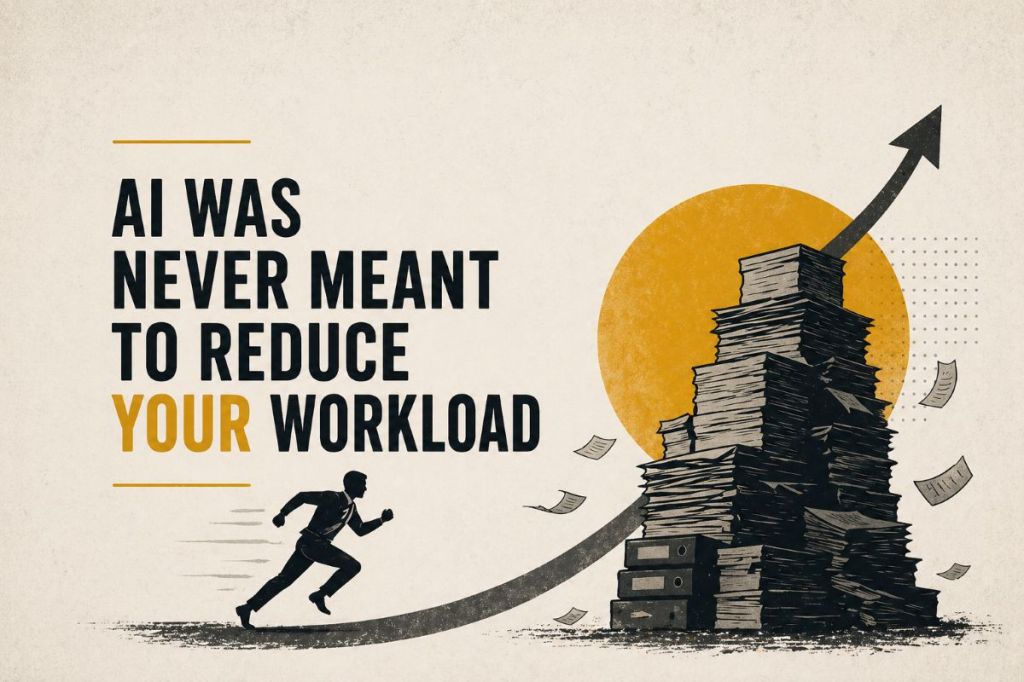
If AI allowed you to finish your work in half the time, would you actually work less… or would more work simply find you?
That’s the question hiding behind most conversations about productivity today. No one wants to talk about it because, when it comes to AI adoption at the workplace, the employer’s promise to the employee is this: “I want AI to take care of your boring tasks, so that you can focus on more important things.”
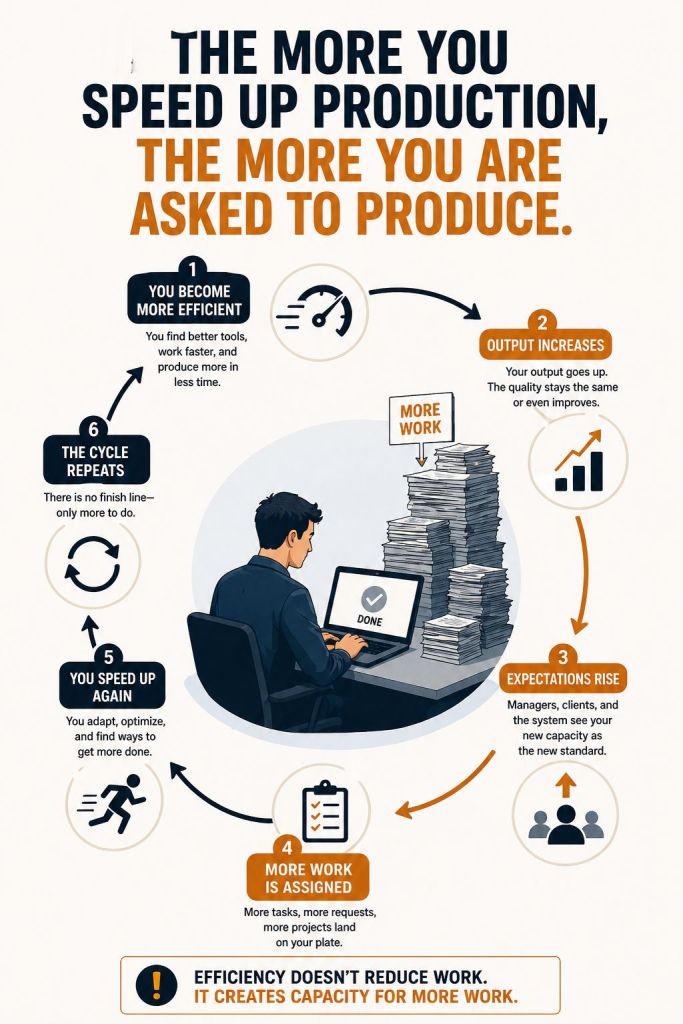
The moment work becomes faster to produce, it multiplies. And the original promise, that efficiency would give you time back, quietly dissolves. Because in most workplaces, time saved is not returned. It is reinvested to increase production. The worker now hears the system whisper, “If you can do more, you should do more.”
A recent research paper on work intensification explored what happens when employees are required to work faster, handle more tasks, and operate under tighter deadlines. What it found is clarifying.
A successful AI adoption doesn’t make work any lighter. Work actually becomes denser. Tasks accumulate, timelines compress, and expectations expand.
People start doing more of the same work. More emails. More drafts. More iterations. More deliverables. And all of this because it became easier to produce.
The result, of course, is exactly what you would expect.
Workers report higher stress, lower clarity, and declining performance. Not because they are doing less, but because they are doing too much without interruption. Their attention is now fragmented, and their thinking is now reactive. Whatever meaning work had is now disappearing.
Here, even efficiency starts working against the employee. The faster he completes tasks, the more tasks he receives. The system adapts in real time. What used to be enough is no longer enough. Output becomes the only signal that matters…
AI was never meant to reduce your workload. How naive of us to have ever believed it. AI was designed to increase what can be produced. And in a system that rewards production, that means one thing.
More work will always find you.
References
Syafri, Muhammad. “The Influence of Work Intensification on Employee Performance through Emotional Exhaustion and Technostress.” Eastasouth Management and Business 4, no. 2 (January 2026): 461–474. https://doi.org/10.58812/esmb.v4i02.


Leave a Reply