
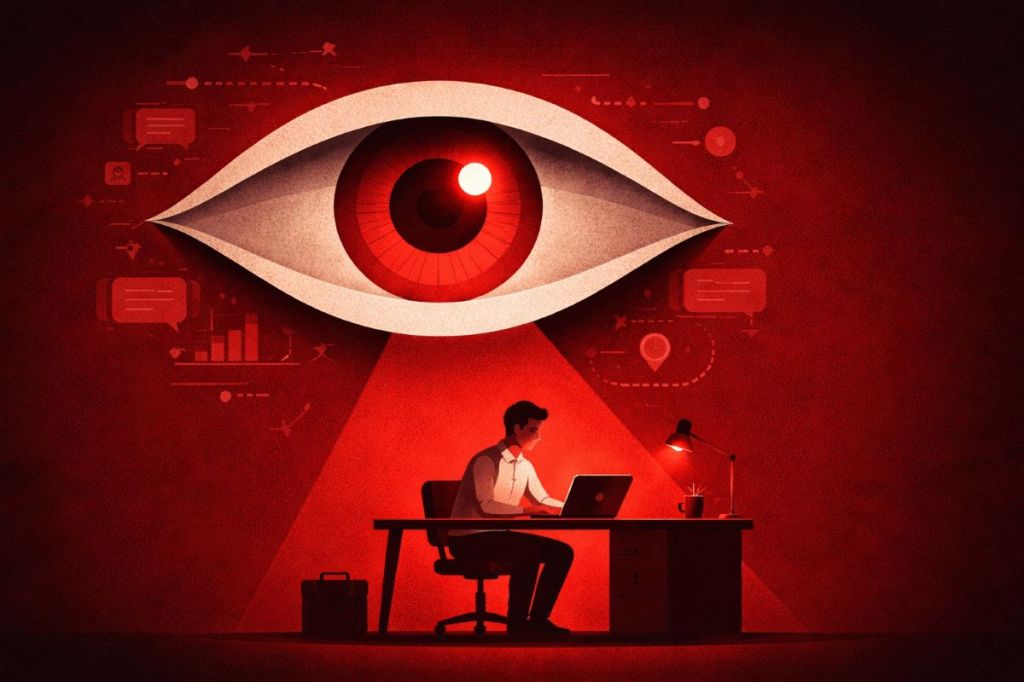
If you had to prove you were working every minute of your day, would you still be doing meaningful work, or would you start performing work instead of actually doing it?
That’s the question hidden under the carpets of modern workplaces. The moment work becomes something you must constantly prove, it becomes a dystopian game one must play in order to survive. And the real outcome of the work becomes a byproduct. Because of surveillance, presence replaces the purpose of work. Instead of focusing on value creation, you start focusing on the metrics you’re measured by. The system whispers, “We don’t trust you unless we can see you.”
A recent research paper titled “It’s Always a Losing Game”: How Workers Understand and Resist Surveillance Technologies on the Job studied this using thousands of worker discussions and interviews. What it found is clarifying.
Workplace surveillance is no longer limited to cameras or timecards. It is now layered, continuous, and invasive. Companies track not just output, but behavior, attention, location, and even emotion. Remote work did not create flexibility, it seems. It created the conditions for total visibility. Laptops became like the telescreens in George Orwell’s 1984…
Employees are monitored through activity trackers, screenshots, keystrokes, idle time, and AI systems that attempt to interpret tone, facial expressions, and engagement. What used to be trust has turned into measurement, i.e., companies dehumanized work by abstracting it.
And the result is exactly what you would expect.
Workers report higher stress, lower productivity, and a growing sense of detachment from their work. They stop optimizing for quality and start optimizing for what is being measured. They take fewer breaks, not because they are more engaged, but because they are being watched. They don’t feel empowered. They feel evaluated.
Even managers are not immune. The same systems that monitor employees also monitor them, creating a loop of pressure, paranoia, and overcorrection. The workplace becomes a system where everyone is watching and no one feels secure.
What is more interesting is how workers respond.
They resist.
They share tactics with each other. They learn how systems work. They find ways to bypass them. They simulate activity. They slow down. They disconnect emotionally. Or they leave.
They are acts of justified adaptation. If the company’s goal is to milk the employee; then, naturally, the employee’s goal ought to be milking the company. When a system becomes too controlling, people stop engaging with it honestly.
Work is neither presence, nor activity, nor time spent in front of a screen. Therefore, these things should not be measured. Work is outcomes.
People do not appreciate being monitored. Not because they have something to hide… Surveillance takes away judgment, autonomy, and dignity. It turns a professional into a tracked entity.
And that model does not scale into the future.
The future of work must not be measured in hours purchased. It ought to be measured in outcomes delivered.
Main Reference:
Sum, C. M., Shi, C., & Fox, S. E. (2025). “It’s Always a Losing Game”: How Workers Understand and Resist Surveillance Technologies on the Job. Proceedings of the ACM on Human-Computer Interaction, 9(2). https://doi.org/10.1145/3710902
 Loor Lemon
Leave a comment