

One of the stranger things about social media is that awareness of your addiction to it doesn’t help much. You know you’ve been scrolling too long, you know you should be sleeping, and you know the work is still waiting. You might even delete the app. Then, somehow, you find yourself doomscrolling again.
A recent qualitative study on problematic internet use found something more interesting than “people are addicted to their phones.” The people interviewed were often very aware of what was happening to them. They recognized the lost time, damaged concentration, procrastination, loneliness, and disrupted sleep. They just couldn’t reliably stop.
The researchers found a recurring pattern:
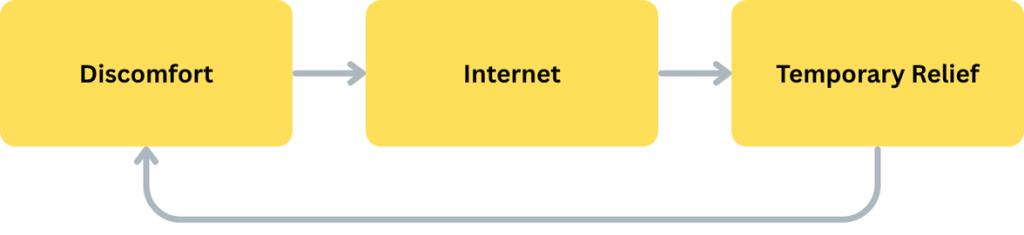
You’re stressed, so you scroll. This helps you stop thinking about the thing stressing you, only for a short period of time. What’s stressing you is still there, but now you’ve also lost an hour. So, you become more stressed than before, and you log in to scroll and scroll again.
The same happens with boredom and loneliness. The internet gives you just enough stimulation (or connection) to keep you there, but almost never enough to satisfy what sent you there in the first place.
Problematic internet use, as we see here, is more about using the internet to avoid something rather than using it because you love it so much.
And unfortunately (almost for everyone), platforms are very good at making that avoidance effortless. Infinite scroll, autoplay, notifications, recommendations, and one app leading naturally into another can make internet use feel less like a sequence of choices and more like a chain that starts running on its own. Your eyes are glued to the screen.
Some participants described picking up the phone almost automatically, opening an app without really deciding to, and realizing only later that they had been scrolling for much longer than intended.
The big question is: Can we expect self-control to defeat environments designed to make stopping difficult? The answer seems to be no.
Knowing what is happening is useful. But knowing, apparently, is not the same thing as being able to stop.
Main Reference
Chatterjee, Diya, and Rishabh Rai. “Aware Yet Unable to Stop: A Qualitative Exploration of Paradoxical Engagement in Problematic Internet Use.” Research Square, May 11, 2026. https://doi.org/10.21203/rs.3.rs-9306043/v1


Leave a Reply