
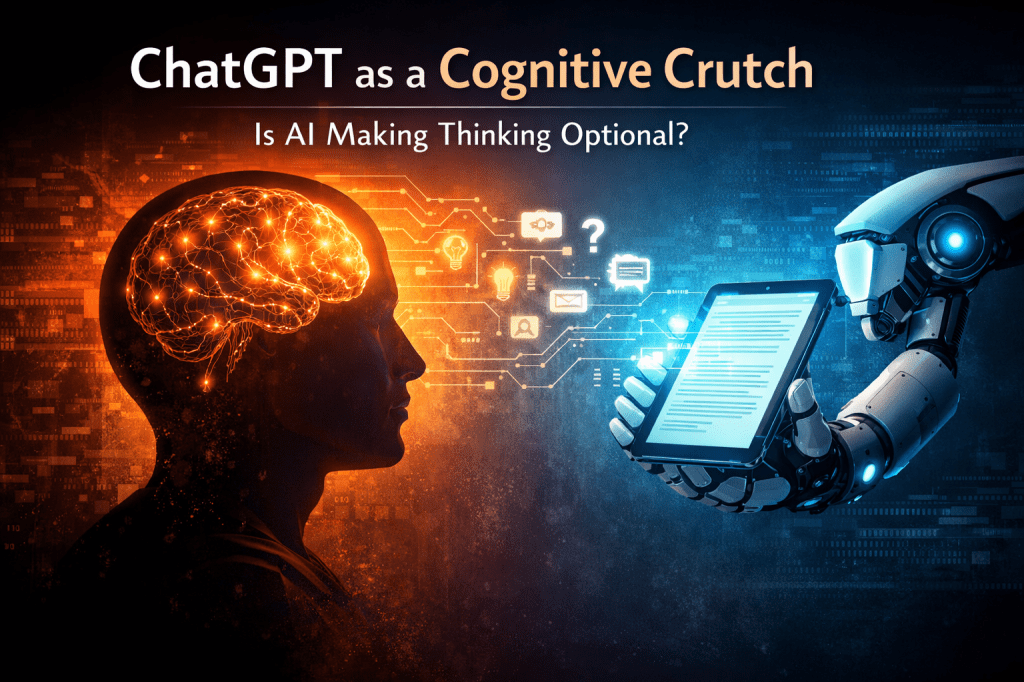
Will humans stop thinking as much as they used to? That is the question. And a recent study (2025) titled “ChatGPT as a Cognitive Crutch: Evidence from a Randomized Controlled Trial on Knowledge Retention” explores exactly that. The results are unambiguous and somewhat unsettling: when students rely on ChatGPT during learning, they tend to remember less later.
This reminds us of an article we posted some time ago called “Why Less AI in Training Might Be the Secret to Better Work,” where three study approaches were tested: a group training with no AI assistance, a group using fully automated AI, and a group using partially automated AI (where AI suggested decisions but humans made the final call). The results were interesting: Participants who trained with partial AI automation outperformed the fully automated group in identifying errors. What was more interesting is that the partial AI group also matched the performance of those trained without AI, which means that can help people learn, only they must be used the right way.
In the article we’re reading today, the researchers conducted a randomized controlled study with university students enrolled in an artificial intelligence course. Participants were split into two groups. One group studied the material using traditional methods such as notes, textbooks, and independent reasoning. The second group was allowed to use ChatGPT as a study aid. To measure real learning, the researchers designed a delayed test. Instead of testing students immediately, they waited 45 days and then gave them a surprise exam covering the material. (This was meant to measure knowledge retention, not short-term performance.)
The difference between the groups was clear. Students who studied using traditional methods scored significantly higher on the delayed test. Students who relied on ChatGPT scored lower. In simple terms, traditional learners remembered more, and AI-assisted learners remembered less.
It’s important to note, however, that the conclusion here is not that AI prevents learning. It suggests that how we use AI matters deeply.
When AI replaces the thinking process, the learning process weakens.
Why ChatGPT can become a cognitive crutch
Two ideas from cognitive science explain the result.
Cognitive offloading: Humans naturally outsource thinking to tools. Calculators replaced mental arithmetic, GPS replaced memorizing routes, and AI now replaces parts of reasoning itself. When the tool does the thinking, the brain does less work.
Desirable difficulty: Learning is stronger when it requires effort. Struggling with a problem, recalling information, and generating explanations all help the brain store knowledge. When AI provides answers instantly, that effort disappears, and retention becomes weaker.
Conclusion
The real lesson of this study is that learning and thinking are inseparable. If AI removes the thinking process entirely, learning suffers. So, the real question today is: “What is the best way we can use AI in learning?”
Main Reference
Barcaui, André. “ChatGPT as a Cognitive Crutch: Evidence from a Randomized Controlled Trial on Knowledge Retention.” Social Sciences & Humanities Open 12 (2025): 102287. https://doi.org/10.1016/j.ssaho.2025.102287
 Loor Lemon
Leave a comment