

Research shows that work meaningfulness, not technical sophistication, determines whether AI adoption strengthens satisfaction and performance.
In one study of employees actively working with AI, researchers examined what actually drives satisfaction and performance in AI-enabled workplaces. The interesting part was this: AI itself was not the determining factor. The presence of advanced tools, automation systems, or generative models did not automatically increase engagement or productivity. What made the difference was how organizations implemented them.
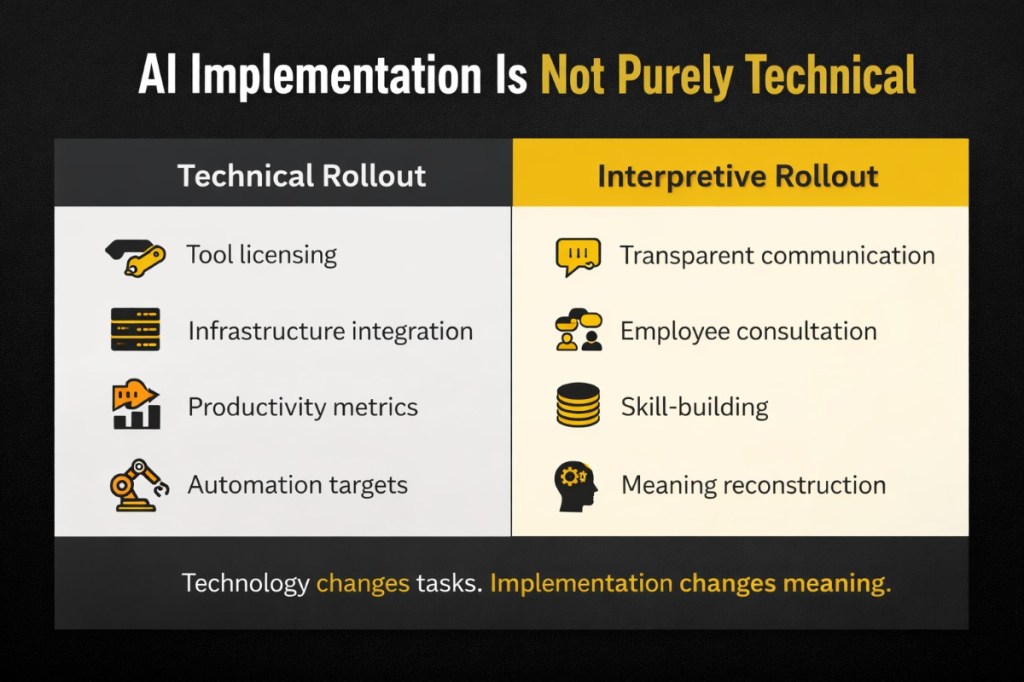
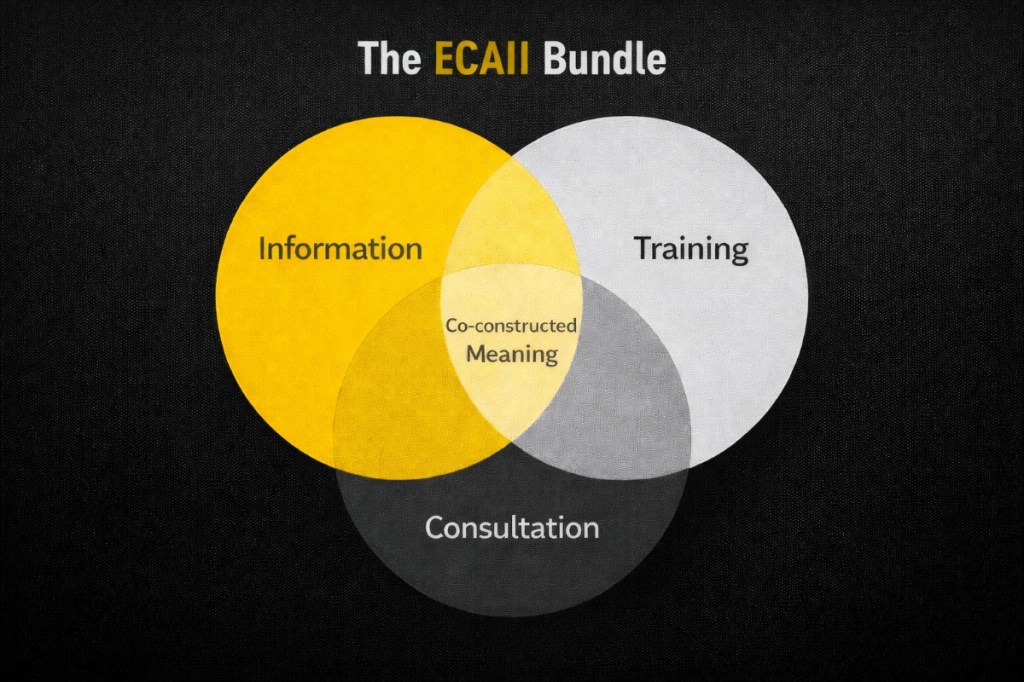
The study introduced the concept of employee-centered AI implementation. This refers to three integrated practices: transparent communication about why AI is being introduced and how it works, genuine consultation that involves employees in decisions related to its use, and structured training that builds both competence and confidence. These practices were not treated as isolated initiatives, but as a coherent philosophy of implementation.
The authors make a critical point: “AI implementation cannot be conceptualized as a purely technical process, but rather as a transformation that affects how employees understand and value their contribution within the organization.”
What this means is simple. AI rollout is not a technical event. It is an interpretive process.
Employees who experienced this kind of structured, participatory implementation reported higher job satisfaction and stronger performance. But the mechanism was not mechanical. It was psychological.
As the study explains, “Work meaningfulness represents a crucial psychological mechanism through which HR practices translate into positive employee outcomes.”
When organizations communicated clearly, consulted employees, and invested in training, employees were more likely to perceive their work as significant and valuable in the new AI-enabled context. That perception of meaning then translated into better attitudes and stronger performance outcomes.
Here is the deeper insight. AI changes the cognitive architecture of work. It shifts decision authority. It alters how expertise is exercised. It can make employees feel displaced or diminished if the transition is poorly handled. But when implementation is participatory, employees do not experience erosion. They experience repositioning.
Technology changes tasks. Implementation changes meaning.
The paper captures this dynamic directly: “Employee-centered strategies such as ECAII may help co-construct new meanings with employees, using practices that ensure AI implementation enhances rather than undermines the meaningfulness of work.”
The study also identified an important boundary condition. The positive effects were significantly stronger among employees who already held favorable attitudes toward AI. When employees were open to AI, employee-centered implementation amplified meaningfulness and performance. When employees were skeptical, the same practices had weaker effects.
Strategy and psychology must align.
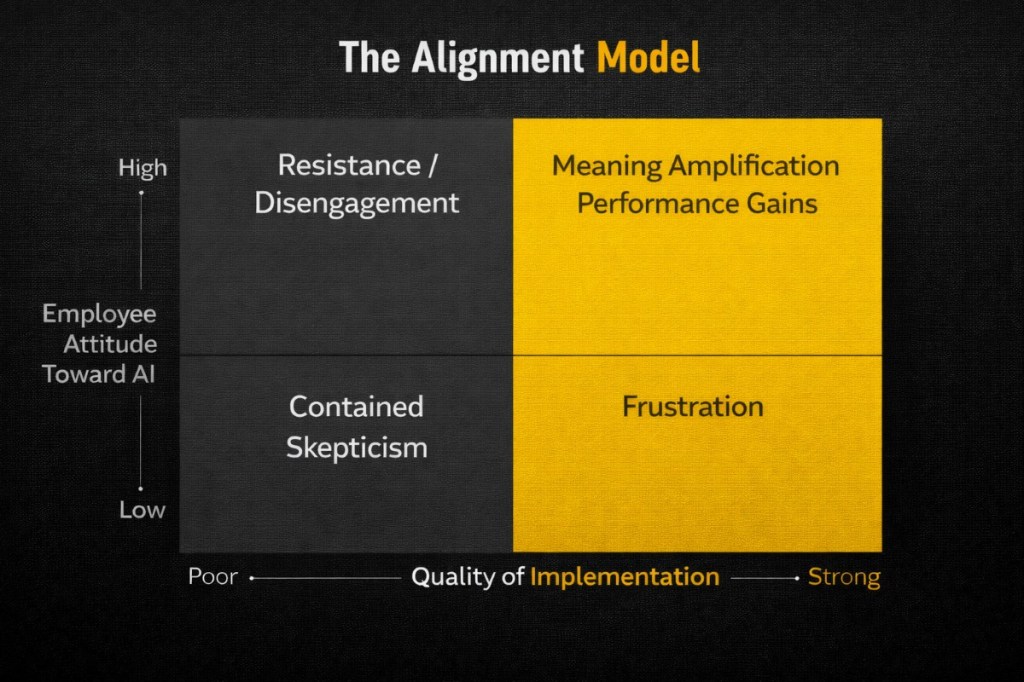
AI adoption succeeds when organizational design and employee orientation move in the same direction.
Most AI strategies focus on infrastructure, licensing models, integration timelines, or productivity metrics. Far fewer focus on the reconstruction of meaning. Yet the data suggest that meaning is not a soft variable. It is a structural performance lever.
If AI implementation is treated as a top-down technical upgrade, performance gains will be fragile. If it is treated as a participatory redesign of how human contribution creates value alongside AI, the gains become sustainable.
Technology scales output. Meaning scales performance.
AI does not automatically make work better. It makes work different. Whether that difference produces higher satisfaction and stronger performance depends less on the algorithm, and more on whether organizations deliberately help employees reinterpret their role within the new system.
That is where AI strategy quietly succeeds or quietly fails.
Source:
Cataldo Giuliano Gemmano et al., Making Artificial Intelligence Work at Work: The Role of Human Resource Practices and Personal Attitudes in Fostering Meaningful Work with Artificial Intelligence, Behavioral Sciences 16, no. 2 (2026): 238. https://doi.org/10.3390/bs16020238
.
 Loor Lemon
Leave a comment