
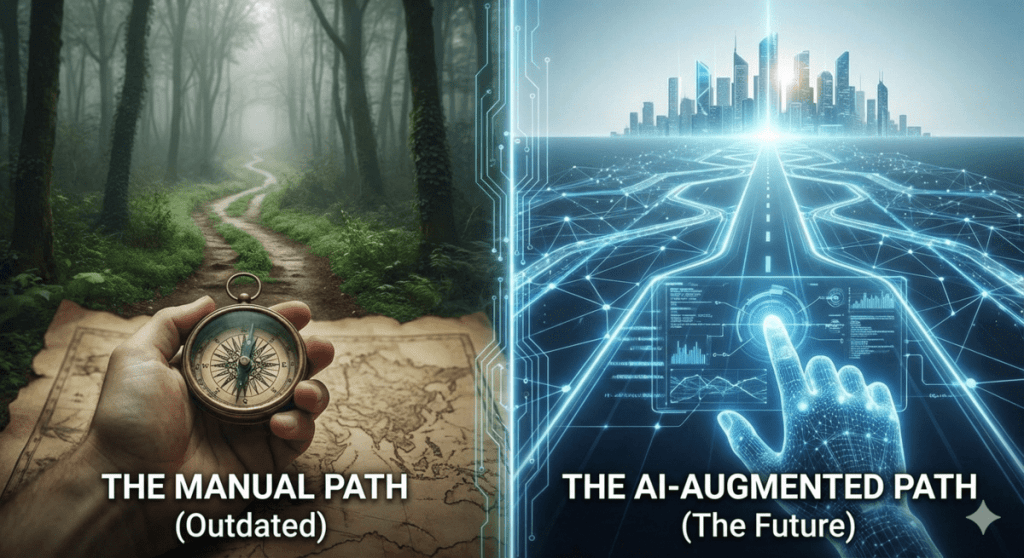
In 2026, the question isn’t if AI will change your job, but how fast it already has. We’ve moved beyond the sci-fi speculation and into a very practical reality: for many professionals, choosing to work without artificial intelligence is becoming a competitive disadvantage so profound it might as well be called “outdated.”
Let’s explore why.
The New “Normal” of Professional Productivity
Think back just a few years. Drafting an email, summarizing a report, or even brainstorming ideas all started with a blank page and the singular effort of your human brain. Today, that’s often no longer the case.
AI has dramatically raised what I call the “Cognitive Floor.” Where we once started every task from zero, an AI-integrated workflow can now begin at 60%, 70%, or even 80% completion.
Instant Synthesis: Need to understand the core arguments of ten complex research papers across different disciplines? An AI agent can provide a coherent, cross-referenced summary in seconds, not hours.
Idea Generation: Writer’s block? Programmer’s block? Designer’s block? AI can instantly churn out dozens of variations, code snippets, or visual concepts, turning the act of “creation” into “curation and refinement.”
Error Reduction: Fatigue, oversight, or simple human error are constant threats in manual workflows. AI doesn’t get tired; it consistently applies logic and pattern recognition, often catching mistakes a human eye would miss.
In essence, AI isn’t just a tool; it’s a co-pilot that never sleeps, a research assistant with infinite recall, and a proofreader with superhuman attention to detail.
The Competitive Chasm
This isn’t just about personal efficiency; it’s about market survival.
If a task takes a human working “manually” ten hours, but an AI-assisted human can achieve the same (or better) result in one hour, the economic reality is stark. In freelance markets, within corporate structures, and even in academic research, the “manual-only” worker is simply becoming too expensive and too slow to compete.
This fact is already communicated on social media: The danger isn’t that AI will replace the expert; it’s that the expert who uses AI will replace the expert who doesn’t.
Where “Manual” Still Reigns (For Now)
So, is all work without AI truly obsolete? Not entirely. There are vital pockets where the human touch, or the absence of AI, remains crucial:
Deep Novelty & True Innovation: AI excels at pattern recognition and recombination of existing data. While it can generate novel combinations, true, paradigm-shifting innovation (the “eureka” moment that leaps beyond current knowledge) still largely belongs to the human mind, often informed by lived experience and intuition.
High-Trust & Security-Critical Environments: For sensitive data, national security, or highly proprietary research, air-gapped, human-only environments are still non-negotiable. The risk of data leakage, however minute, often outweighs the efficiency gains of AI.
Craft, Artistry, and the Human Premium: Paradoxically, as AI automates more, “handmade” (both physically and intellectually) is becoming a mark of luxury and authenticity. The “human touch” carries social capital precisely because it is inefficient. Think of bespoke tailoring versus mass production, or a hand-painted portrait versus a digitally generated one. The value isn’t just in the output, but in the human effort and intention behind it.
The “Warp Drive” for Your Mind
Steve Jobs once called the computer a “bicycle for the mind.” If that’s the case, then AI is rapidly becoming a warp drive. You can still ride the bicycle. It offers unique benefits, keeps you grounded, and sometimes, it’s just a more pleasant way to travel. But if your goal is to reach distant galaxies (or just hit a challenging deadline), the bicycle is undoubtedly “outdated” for the journey.
The conversation has shifted from “should we use AI?” to “how intelligently can we integrate AI?”
 Loor Lemon
Leave a comment